


Why Choose Us
High-Quality Products
We specialize in manufacturing CNC routers, nesting CNC machines, CNC plasma cutting machines, laser cutting machines engraving machines, etc.
Wide Range of Applications
These machines can be used for wood furniture making, the decoration industry, the advertising industry, the art field, the mold production field, etc.
Foreign trade market
We have exported our products to many countries and regions all over the world, especially America, Europe, Oceania and Southeast Asia.
Company Honor
We have SGS, CE certification, etc. We enjoy a good reputation among our customers. We welcome customers from all parts of the world to contact us and seek cooperation for mutual benefit.
What is Wood Turning Lathe Machine
A wood lathe is a type of lathe that's designed specifically for woodworking applications. In other words, they are used to cut, sand, drill, face, turn and deform wooden workpieces. They still work like all other lathes by exposing a rotating workpiece to a stationary cutting tool. But wood lathes are used specifically to work wooden workpieces. They are not suitable for workpieces made of harder materials, including metal.Wood lathes are smaller and simpler than their metal counterparts. The speed at which they rotate workpieces is controlled by a basic pulley system. They don't produce as much power as metal lathes, but wood lathes are highly effective at manipulating wooden workpieces.

Automatic Design
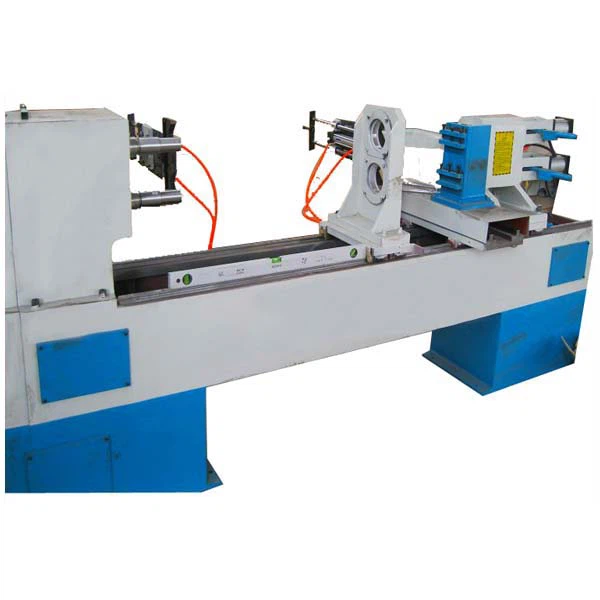
This machine is designed to work on its own, without any manual intervention. If you need to create the exact same design repeatedly, this machine will take care of it. With the Hand Rails Wood Lathe Machine, you'll have more precise and uniform handrails, which will increase the value of your product.
Fast and Accurate
This machine is created for high-speed production without compromising the design or quality. With its powerful motor and high-precision spindle, it can quickly and accurately create handrails at a faster rate. This machine can dramatically reduce your manufacturing time, and increase your profits.
Versatile
The Hand Rails Wood Lathe Machine provides versatility in the handrails it can make. You can create a variety of designs with different profiles, shapes, and sizes. The machine is suitable for creating handrails for residential and commercial buildings, schools, hospitals, airports, and other applications. The machine is compatible with most wood types, including softwood and hardwood.
Easy to Operate
Using the Hand Rails Wood Lathe Machine is very simple, with a user-friendly interface that simplifies the process. The machine comes with a comprehensive user manual, making it easy for anyone to operate. Even beginners or woodworkers who have never used a lathe before, can easily learn how to operate the Hand Rails Wood Lathe Machine.
Quality Materials
We used the best materials to manufacture this machine to ensure it has a long life-span. The machine is made of high-quality materials that are durable and sturdy, making it capable of handling continuous, high-volume use without deteriorating.
What are the Applications of Wood Turning Lathe Machine
Manufacturing Industry
Lathes are indispensable for producing metal components like gears, bolts, and rods. They ensure precision and efficiency in the production line.
Automotive Industry
Engine lathes are used for machining engine parts, brake drums, and flywheels, contributing to the assembly of vehicles.
Aerospace Industry
CNC lathes are crucial for fabricating high-precision parts such as turbine blades and various aerospace components.
Woodworking
Wood lathes are employed for turning wood to create intricately designed furniture, decorative items, and architectural details like table legs.
Metalworking
Metal lathes are essential for shaping metals into desired forms, crucial for creating machine parts, tools, and custom metal pieces.
Jewelry Making
Mini lathes are used to shape and polish precious metals and stones, aiding in the creation of intricate jewelry designs.
Shipbuilding
Large, industrial-scale lathes are used for shaping parts of ships, including propeller machining.
Glass Working
Specialized lathes are utilized for precision glass working, useful in creating scientific instruments and artistic glass pieces.
Types of Wood Turning Lathe Machine
Centre Wood Lathe
Centre lathes are the most widely used types of lathes. In the early days, the transmission of ordinary lathes was driven by a belt-transmitted tower wheel. Today, gear transmissions have been used. The advantage of the gear transmission is that it can accurately grasp the speed of the main shaft, and there is no situation where the speed of the main shaft is too high, the friction of the belt is consumed and slips. Because the main shaft is placed horizontally, it is also called a horizontal lathe. If the bed surface is notched, it is a notched lathe machine.
Bench Wood Lathe
Bench lathe machines are also called tabletop lathe machines. Their type and structure are similar to centre wood lathes. They are usually installed on work tables and named after them. They are suitable for the production of precision measuring tools, instruments and small parts.
Vertical Wood Lathe
The main axis of the vertical lathe is installed vertically, the bed is horizontal, and the workpiece is placed on the rotatable bed. Especially suitable for processing workpieces with large diameter but short length.
Turret Wood Lathe
Hexagon lathe, also known as turret lathe, is designed to replace the tailstock of ordinary lathe with a hexagonal rotating turret. Especially suitable for processing a large number of workpieces in various processing procedures (such as drilling, reaming, boring), suitable for mass production.
Automatic Wood Lathe
The automatic lathe can automatically turn according to the processing order of the work. After turning, it will automatically retract the tool, feed, and turn the next finished product. It is suitable for mass production of small diameter workpieces.
Copying Wood Lathe
Copying lathes, also known as imitation turning lathes, use the stylus to move according to the shape of the model or template, and the turning tool also moves the turning work, so the same workpiece as the model can be turned correctly.

Turning
This involves shaping the wood into a cylindrical form, such as a table leg or a bowl.
Facing
This involves creating a flat surface on the end of a piece of wood, such as for a table top or a chair seat.
Drilling
This involves creating holes in the wood, such as for dowels or decorative features.
Parting
This involves cutting a piece of wood off from the main body, such as for creating multiple pieces from a single block.
Sanding
This involves smoothing the wood surface using sandpaper or other abrasive materials.
Knurling
This involves creating a decorative pattern on the wood surface.
Thread cutting
This involves cutting threads on the wood surface, typically for creating wooden screws or other threaded components.
How to Choose Wood Turning Lathe Machine
Size Consideration
The very first feature you should look at is the overall size of the wood lathe that will determine your project limit, and you have three options in the market.
Materials
The most common type of material used in the wood lathes is cast iron. It is great at absorbing the vibration and that's why most of the lathes are made from Cast Iron. You can also see materials like- steel or stainless-steel bed with cast iron legs. These lathes are much more efficient at dampening vibrations.
Motor
Check out how much horsepower the motor of your lathe can supply. This is the engine of your wood lathe, so it is one of the most vital features to consider. Check the power requirement to see if it would be enough.My Rockler mini produces ½ HP, just like any other typical pen making small lathes.
Spindle Thread Size
It is imperative to know the size of the headstock spindle thread. The larger the diameter of your spindle, the more rigid it will be for the bigger work. And you need to know the thread size of your spindle to get the accurate chucks and faceplate from aftermarkets.
Spindle Bore
This is the hole that goes all the way through the spindle. It will determine what size knockout bar you can use to knock out the centers and what type of vacuum chuck adapter you can buy.Lathes that are direct drive don't have a spindle bore. You can still use this, but this makes life a bit difficult during knock out the centers.
Morse Taper
You can see the morse taper at the end of your centers and accessories that fit inside the spindle and the tailstock quill. They will go in with a friction fit and are usually knock back out.
Wood Turning Lathe Machine Features
Convenient and easy to use
Woodworking lathes are not only easy to install and disassemble, but also easy to operate. It mainly consists of a base, a workbench, a spindle and a motor. Just fix the wood on the spindle, press the switch, and it's ready to use. It is also lightweight and compact, suitable for use at home. It can help beginners get started smoothly without causing much impact on family life.
save space
Compared with traditional tool lathes, woodworking lathes are more flexible and versatile because they do not require a separate base, motor, etc. to take up a lot of space. When in use, you only need to place the woodworking lathe on a table or workbench, and you can easily complete various woodworking projects. It is also convenient for storage and does not take up too much space.
Multifunction
Woodworking lathes are not only suitable for making small wood products and handicrafts, but also for making pens, tableware, vases, bowls and other small utensils. If you are a woodworking enthusiast, owning a desktop wood lathe will allow you to complete more projects and improve your crafting skills.
Safe and reliable
The design of the woodworking lathe makes it safer and more reliable and will not hurt your fingers. Most devices are equipped with fuses and fuses to ensure that nothing unexpected happens during use. In addition, desktop wood lathes can be connected to other equipment to ensure greater safety during use.
The Working Process of a Wood Turning Lathe Machine
Preparation and Setup
Before any lathe operation, it's essential to prepare the machine and workpiece. This includes ensuring the lathe machine is clean and all components, such as the lathe bed, headstock, and tailstock, are properly aligned. The workpiece is then securely mounted to the lathe. This could be done between centers in the headstock and tailstock, or more commonly, by attaching it to a chuck or faceplate connected to the spindle.
Selecting and Installing the Cutting Tool
A suitable cutting tool is chosen based on the material of the workpiece and the desired operation. The tool is then securely fixed onto the tool post or a tool holder, ensuring it's correctly positioned and at the appropriate distance from the workpiece.
Setting Spindle Speed
The spindle speed is a critical factor in lathe operations. It must be set according to the type of material and the specific cutting operation. The lathe's electric motor powers the main spindle, dictating the rotational speed of the workpiece.
Engaging the Feed
After setting the spindle speed, the next step is to engage the feed. The feed moves the cutting tool along the longitudinal direction of the lathe bed or in a cross-slide motion, allowing for precision cutting. This movement can be manually controlled or set to move automatically at a steady rate, determined by the lead screw and feed rod mechanisms.
Performing the Cutting Operation
The cutting process begins by bringing the tool into contact with the rotating workpiece. The lathe removes unwanted parts from the workpiece, shaping it as it rotates. Operations such as turning, facing, grooving, and threading are performed by moving the tool against the workpiece in various directions and depths.
Monitoring and Adjusting
Throughout the operation, it's crucial to monitor the cutting process and make necessary adjustments. This includes checking the shape and dimensions of the machined workpiece, ensuring the cutting tool remains sharp and effective, and adjusting the feed rate and spindle speed as needed.
How to Maintain Wood Turning Lathe Machine
Dust is arguably the biggest enemy of wood lathe machines. It can easily cause damage to the machine if not taken care of. Wood shavings and dust can be removed from the lathe machine after turning wood. As for cleaning dust, the operator can use a vacuum cleaner or compressor to reach the hidden places in the lathe every week. Key areas to consider include blowing dust around the tailstock, electric motor, banjo, and the morse taper holes of the headstock and tailstock. A lint-free cloth can then be used to wipe out the blown areas.
Every metallic machine is susceptible to rust, and wood lathes are no exception. If anything, they stand a higher chance of getting rust when the machine turns greenwood. Greenwood has sap that contains tannins and compounds that accelerate rusting depending on the tree species. Parts made of cast iron such as tool rest, banjo, bed rails, and tailstock can quickly be coated with rust if they're neglected. Despite these, some solutions can get rid of rust on wood lathes. Operators can use rust removal when rust has been spotted on the machine. Spraying the solution on rust will cause it to clear. Besides this, the sandpaper of 400 grit or lower can be used to sand the affected areas with remarkable results. It's recommended that an inspection of rust is conducted every month.
The banjo needs to be able to move around effortlessly, and failure to do this indicates that it needs lubrication. Besides improving mobility, lubrication can preserve the metal because most oils give metals a coating that protects the surface from water, which causes rusting. Before applying lubrication, the bed rails and banjo should be cleaned well and dried before paste wax or any other lubricant is applied. The lubricant should be allowed to dry before the metal surface is buffed up with some clean, soft cloth. Ideally, lubrication should be applied weekly.
The tool rest is bound to have marks on its top edge due to materials falling. During woodturning, catches can lead to woodturning tools smacking the bowl gouge or scraper on the tool rest. When the tool rest surface is interrupted, it'll affect all the tools working on that surface. Therefore, a flat metal file can be used to make long angled strokes across the top of the tool rest to file away rough areas and smoothen the edge every 6 months.
Every month, the banjo and tailstock must be explicitly maintained because they're attached to other components such as drive screws. Removing them from the lathe machine also allows the operator to clean off any debris or cavities that may have built up in the process of woodturning. The bottom surfaces that contact the bed rails can also be lubricated with a lubricant such as paste wax. It would also be possible to lubricate the drive screw because the tailstock has been removed. Once the banjo and tailstock are reinstalled, they should be able to move smoothly on the bedrails, and the locking screw should lock and unlock easily.
Before use,should check carefully all parts of the lathe such as tools,chucks,whether flexible and reliable.The work piece should be clamped and pressed with a thimble, and try by hand first before starting.Confirm the good condition before starting the operation.
It should be based on the hardness of the workpiece wood, choose the suitable feeding material, adjust the speed when operate.
In the process of turning,do not touch to check the smoothness of the work piece to avoid accidents.To remove the tool hold first,then use sandpaper for grinding.When woodworking lathe rotation,can not use hand brake.
When square wood is processed, it must be processed into a cylinder before it can be processed on the lathe.
Our Factory
JINAN ZHONGKE CNC EQUIPMENT CO.,LTD is a professional manufacture of CNC machines for more than 15 years, we have our own workshops , warehouse and sample machine display area. We are located in Jinan City ,Shandong province and is specialized in manufacturing CNC routers, nesting CNC machines, CNC plasma cutting machines, laser cutting machines and engraving machines etc. These machines can be usd for wood furniture making, decoration industry, advertising industry, art field, mold production field, etc. Also have SGS, CE certification, etc.With an experienced and professional team, we have exported our products to many countries and regions all over the world, especially America, Europe, Oceania and Southeast Asia. At the same time, we have a professional technical team, which can carry out on-site training and after-sales.We enjoy a good reputation among our customers. We welcome customers, business associations and friends from all parts of the world to contact us and seek cooperation for mutual benefits.Welcome to Jinan Zhongke CNC Equipment Co.,ltd to visit our machines!


Our Certificates


FAQ
Q: What is a wood turning lathe machine?
Q: What is the difference between a lathe and a wood lathe?
Q: What are the advantages of wood turning?
Q: Which lathe is used for woodworking?
Q: Is using a wood lathe hard?
Q: What are the disadvantages of a lathe?
Q: Can a wood lathe be used as a metal lathe?
Q: Can you turn plywood on a lathe?
Q: Can you turn wet wood on a lathe?
Q: What should I avoid using a lathe machine?
Q: Can you make a living turning wood?
Q: Can you do boring on a lathe?
Q: Can you turn MDF on a lathe?
Q: What should I check after using a wood lathe?
Hardened woodturning tools can damage the tool rest over time. Catches, which can occur when turning a wood bowl, can lift and smack a bowl gouge or scraper down onto the tool rest. If a tool rest is made of cast iron, it is very common to find many nicks and gouges along the tool rest top edge.
Q: What is the most frequently used lathe?
Q: What should you do before operating a lathe machine?
Q: How long should wood dry before turning on a lathe?
Q: How far away should the tool rest be from the wood on a lathe?
Q: Should you wear gloves when using a lathe?
Q: What must you never do while working on a lathe?
We're well-known as one of the leading wood turning lathe machine manufacturers and suppliers in China. Please rest assured to buy high quality wood turning lathe machine for sale here from our factory. For price consultation, contact us.
Stair Handrail Wood Lathe Machine, cnc machining for business, cnc machining for odm