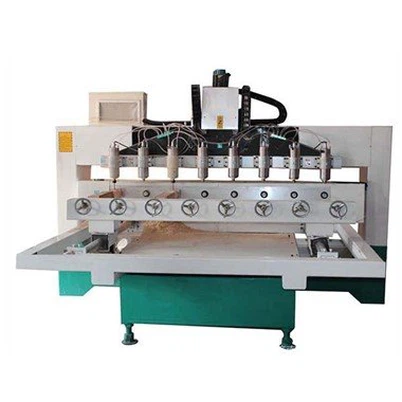
Dual Table Engraving Machine
The Dual Table Engraving Machine is an industrial-grade CNC routing center engineered for non-stop batch production. By dividing the workspace into two independent, alternating machining zones, the system eliminates loading and unloading downtime.
Description
Product Overview
The Dual Table Engraving Machine is an industrial-grade CNC routing center engineered for non-stop batch production. By dividing the workspace into two independent, alternating machining zones, the system eliminates loading and unloading downtime. One table executes precision cutting programs while the operator sets up materials on the adjacent table, maintaining uninterrupted spindle utilization.
Constructed on a heavy-duty, stress-relieved steel gantry and chassis, this machine supports high-feed cutting, routing, drilling, pocketing, and profiling. It delivers repeatable accuracy on wood, engineered plastics, solid surfaces, non-ferrous alloys, and advanced composites.
Key Features
Dual Table Production Design: The dual-table layout isolates machining from material handling. The CNC controller switches active coordinates between Zone A and Zone B automatically, allowing continuous material throughput without spindle idle cycles.
Rigid Machine Structure: A heavy-gauge welded steel frame undergoes thermal stress-relieving to guarantee long-term structural alignment. The vibration-damping chassis ensures clean edge finishes even during demanding, high-feed lateral cuts.
Precision Motion System: High-precision linear profile rails and preloaded motion components drive all axes. This mechanics setup delivers precise positioning tolerances and excellent geometric accuracy across the entire working envelope.
Flexible CNC Configuration: The platform accommodates specific production setups, including high-torque spindle packages, pneumatic positioning stops, automatic tool carousels, and multi-zone vacuum distribution.
Technical Specifications
|
Parameter |
Specification |
|
Machine Type |
Dual Table CNC Engraving Machine |
|
Working Area |
Tailored to client production footprints |
|
Table Structure |
Dual Independent Working Tables (Zone A / Zone B) |
|
Spindle Power |
High-frequency spindle (various kW/HP options) |
|
Spindle Speed |
Variable, up to 24,000 RPM via variable frequency drive |
|
Drive System |
High-torque AC Servo / Digital Stepper Systems |
|
Transmission System |
Precision Helical Rack & Pinion (X/Y axes), Ball Screw (Z axis) |
|
Control System |
Industrial-grade CNC Controller |
|
Tool Changing |
Optional Linear or Rotary Automatic Tool Changer (ATC) |
|
Table Type |
High-vacuum matrix with integrated T-slot channels |
|
Processing Materials |
Hardwood, MDF, Acrylic, Polycarbonate, Solid Surface, Non-ferrous Metals |
|
Application |
2D/3D Engraving, Routing, Profiling, Drilling, Pocketing |
Dual Table Working Principle
The operational workspace is divided into two safety-isolated zones. A specialized CNC interface controls independent vacuum hold-down fields and safety light barriers for each table.
During operation, the gantry processes the workpiece in Zone A. Simultaneously, the operator clears finished parts and loads raw sheet stock in Zone B. Once the active cycle in Zone A completes, the spindle instantly transitions to Zone B to begin the next program. This alternating cycle optimizes machine utilization, making it ideal for large-scale production of cabinet parts, signage components, and architectural panels.
Processing Applications
This multi-material processing center is utilized across diverse manufacturing sectors:
Cabinetry & Furniture Production
Nesting, sizing, and boring of cabinet boxes and doors.
Architectural Millwork
Profiling, molding, and intricate 3D decorative panels.
Signage & Exhibition Displays
Cutting dimensional letters, acrylic parts, and lightboxes.
Plastic Fabrication
Machining of HDPE, PVC, nylon, and polycarbonate components.
Composite Machining
Routing carbon fiber, fiberglass, and solid surface materials.
Industrial Pattern Making
Precision milling of prototypes and casting molds.
Customization Options
Every machine is configured to integrate into specific factory workflows:
Custom Table Dimensions: Matched to regional material sheet standards.
Spindle Packages: Ranging from light-duty air-cooled to high-torque liquid-cooled units.
Tool Management: Systems including linear or rotary ATC configurations (up to 16 slots).
Material Hold-Down: Setups featuring customizable multi-zone vacuum layouts and dedicated pumps.
Safety Options: Such as optical light curtains, safety mats, or complete machine enclosures.
Electrical Adaptations: Configured to match local industrial power grids (voltage, phase, and frequency).
Manufacturing & Quality Control
Every CNC center undergoes a rigorous, multi-stage quality verification process prior to dispatch:
Metallurgical & Structural Inspection: Ultrasonic testing of structural welds.
Precision Alignment Calibration: Dial indicators align guide rails to micro-level tolerances.
Dynamic Laser Interferometry: Verification of axis positioning and repeatability accuracy.
Spindle Run-out Analysis: Dynamic balance testing across the entire RPM spectrum.
Electrical Safety Diagnostics: Complete insulation and ground loop continuity testing.
72-Hour Load Simulation: Continuous dry-run operation to verify system reliability under load.
Certifications & Compliance
Manufacturing protocols and electrical cabinets conform to global safety and industrial guidelines:
CE Declaration of Conformity
For European machinery directives.
ISO9001 Quality Management
Standards for manufacturing operations (compliance documentation is provided in accordance with final machine specifications).
Packaging & Global Delivery
To guarantee damage-free arrival, each machine is secured with heavy-duty export packaging designed for long-distance transit:
Anti-Corrosion Coating
All bare metal surfaces are treated with industrial rust-preventatives.
Vapor-Barrier Sealing
The entire machine is enclosed in thick, vacuum-sealed barrier film.
ISPM-15 Wooden Crating
The system is housed inside heat-treated export crates.
Structural Anchoring
Steel brackets lock the gantry and tables to the skid base to eliminate transit movement.
FAQ
Q: What is the primary operational advantage of a dual table engraving machine?
A: The dual-table design allows simultaneous machining and material handling. By eliminating loading intervals, it maximizes active spindle cutting time, resulting in higher throughput compared to single-table machines.
Q: What materials can this CNC engraving machine process?
A: It processes wood, MDF, plywood, plastics (acrylic, HDPE, polycarbonate), solid surfaces, fiberglass, and soft non-ferrous metals such as aluminum and brass.
Q: Can the machine be customized for different production needs?
A: Yes. Table sizes, spindle specifications, vacuum hold-down configurations, tool changing capacities, and control interfaces can be customized to match your specific application requirements.
Q: Is an automatic tool changer available?
A: Yes. An automatic tool changer (ATC) in either linear or rotary configurations can be integrated to handle multi-tool files without manual intervention.
Q: What support is provided before shipment?
A: Every machine undergoes physical assembly verification, spindle run-out calibration, coordinate accuracy testing, and a continuous 72-hour operational run before leaving the factory.
Hot Tags: dual table engraving machine, China dual table engraving machine manufacturers, suppliers, factory, cnc router, cnc router sample, cnc router sanding, cnc router scratch resistance, cnc router software, cnc router texture
Send Inquiry
You Might Also Like